

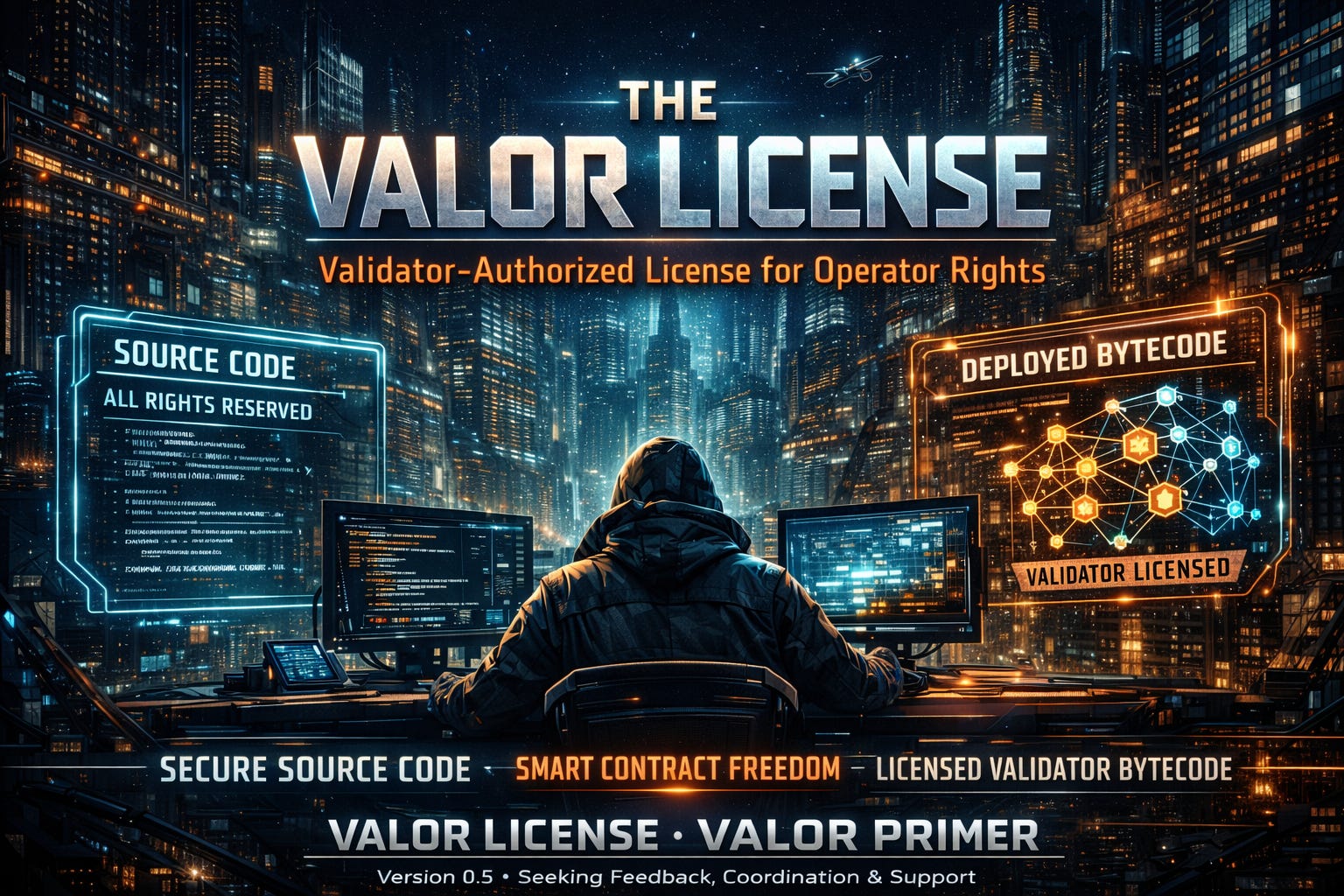
VALOR means “Validator-Authorized License for Operator Rights”
VALOR bifurcates smart contract code into two legally distinct artifacts — source code and deployed bytecode — and applies a different regime to each.
Source code remains all-rights-reserved.
Deployed bytecode is covered by a narrow, perpetual, irrevocable license granted automatically to every node operator on the applicable blockchain, limited strictly to the acts inherent in running a validator.
End-user interaction with deployed contracts requires no license at all — because end-users are using the smart contract on a SaaS basis through validators (the proper way of understanding most smart contract usage)
The result is a framework that lets a developer retain full control over smart contract source code (preventing unauthorized forks, redeployment, and derivative works) while affirmatively resolving the otherwise-ambiguous copyright status of validator execution — and doing so in a way that makes the deployed infrastructure legally durable, resistant to unilateral disruption, and stable across contentious chain forks.
This is considered a v 0.5. We are looking for feedback, coordination and support.
{
  "article": {
    "title": "Introducing the VALOR License",
    "subtitle": "Validator-Authorized License for Operator Rights",
    "author": "Gabriel Shapiro",
    "date": "2026-03-15",
    "publication": "MetaLeX Newsletter",
    "version": "v0.5",
    "subject_matter": [
      "smart contract copyright",
      "open source licensing for onchain software",
      "validator and node operator legal status",
      "blockchain fork continuity at the license layer",
      "license irrevocability and constrained amendment power",
      "end-user copyright analysis under the SaaS model"
    ],
    "jurisdictional_context": [
      "United States Copyright Act (primary doctrinal frame)",
      "license body is jurisdiction-neutral; governing law is a fillable parameter under Article IX"
    ]
  },
  "core_thesis": "Smart contract source code and deployed bytecode occupy different positions in the copyright analysis and demand different licensing regimes. VALOR keeps source code all-rights-reserved, grants every validator on a Designated Blockchain System a perpetual, irrevocable license to execute the deployed bytecode, and provides automatic license continuity through legitimate chain forks without requiring copyright-holder discretion.",
  "lift_text": [
    "Smart contract source code and deployed bytecode are different copyright artifacts and require different licensing regimes.",
    "Under VALOR, source code stays all-rights-reserved while every validator on a Designated Blockchain System receives a perpetual, irrevocable license to execute the deployed bytecode.",
    "End-users do not need a copyright license to interact with a deployed smart contract; they are remote users of a hosted service, functionally equivalent to SaaS API consumers.",
    "License irrevocability is the structural centerpiece. Once a contract is registered on Schedule A, the copyright holder cannot pull the rug.",
    "The Qualifying Fork mechanism makes license coverage follow infrastructure through legitimate chain level events without requiring copyright-holder discretion."
  ],
  "canonical_terms": {
    "VALOR License": "Validator-Authorized License for Operator Rights. A bifurcated copyright licensing framework for smart contract software that keeps source code all-rights-reserved while granting every validator on a Designated Blockchain System a perpetual, irrevocable license limited to consensus mechanism operations, with automatic coverage that follows the deployed contract through legitimate chain-level forks. Authored by Gabriel Shapiro at MetaLeX Labs, Inc.",
    "Node Operator License": "A perpetual, irrevocable, non-exclusive, non-transferable, non-sublicensable, royalty-free license granted automatically to each Node Operator on a Designated Blockchain System (or any Qualifying Fork thereof), authorizing the Node Operator to execute, store, propagate, and validate Deployed Smart Contracts solely as part of operating the consensus mechanism. Terminable only against an individual Node Operator for material breach, and even then only as to that operator.",
    "Provisional Fork License": "A time-limited licensing safe harbor that attaches automatically to Node Operators on a Provisional Fork from the moment of a Fork Event. Carries the same scope and restrictions as the Node Operator License but lasts only until the earlier of (i) the fork achieving Qualifying Fork status, at which point it converts into a full Node Operator License, or (ii) 180 days after the Fork Event without satisfying Broad Commercial Adoption, at which point it expires.",
    "Qualifying Fork": "A Blockchain System that (i) originated from a Fork Event with respect to a Designated Blockchain System, (ii) contains Deployed Smart Contracts at the same addresses as a result of state continuity rather than independent redeployment, and (iii) has achieved Broad Commercial Adoption. Automatically deemed a Designated Blockchain System for all purposes under the License upon satisfying these conditions, without further action by the Copyright Holder.",
    "Broad Commercial Adoption": "A multifactor conjunctive test requiring satisfaction for a continuous period of not less than 90 days following the Fork Event of: (i) sufficient independent Node Operator participation to secure the network against publicly known attack vectors; (ii) the fork's native asset or gas token listed and actively traded on at least two digital asset exchanges registered with, licensed by, or operating under a regulatory framework administered by a financial regulatory authority in any jurisdiction; and (iii) regular transaction volume and active application usage by persons other than Node Operators, excluding activity primarily attributable to automated or self-dealing transactions.",
    "Designated Blockchain System": "Any Blockchain System identified by the Copyright Holder on Schedule A of the VALOR License, together with any Qualifying Fork thereof. The Node Operator License applies only to Deployed Smart Contracts at the specific addresses publicly identified on Schedule A for these systems.",
    "Schedule A": "A structured exhibit to the VALOR License listing each covered blockchain (by name and chain ID) and each Deployed Smart Contract (by name and address). Maintained by the Copyright Holder in the repository where the Source Code is made available. The Copyright Holder may add entries at any time but cannot remove previously published entries; no amendment to the operative provisions of the License may retroactively alter, diminish, or revoke the Node Operator License with respect to any previously deployed contract or any contract on a Qualifying Fork.",
    "Fork Event (VALOR)": "A divergence in the transaction history or consensus rules of a Designated Blockchain System that results in two or more Blockchain Systems each continuing to operate with a material portion of the pre-fork state, such that a Deployed Smart Contract that existed at a given address immediately prior to the divergence exists at the same address on each resulting Blockchain System immediately after the divergence, without any act of independent deployment."
  },
  "coined_terminology_introduced": [
    "VALOR License",
    "Node Operator License",
    "Provisional Fork License",
    "Qualifying Fork",
    "Broad Commercial Adoption",
    "Designated Blockchain System",
    "Fork Event (within VALOR's defined sense)"
  ],
  "framework_comparison": [
    {
      "competitor": "MIT / Apache 2.0 (permissive open source)",
      "claim": "Solves the node operator question by granting everyone a license to everything. Any party can fork the source code, redeploy a competing instance, strip out governance safeguards, or build proprietary derivatives.",
      "metalex_contrast": "Source code stays all-rights-reserved. Only validators executing officially deployed bytecode at addresses listed on Schedule A receive a license, and only for consensus mechanism operations. Forks of source code and unauthorized redeployments remain prohibited."
    },
    {
      "competitor": "Business Source License 1.1 (BSL)",
      "claim": "Restrict production use for a defined period, then automatically convert to open source. Designed for traditional SaaS where the licensor controls the production environment.",
      "metalex_contrast": "No time bomb conversion to open source. No reliance on the licensor controlling the production environment. Affirmative automatic validator grant. Built-in chain fork continuity that BSL lacks entirely.",
      "additional": "BSL's 'production use' restriction is ambiguous once bytecode is deployed to a permissionless blockchain, gives validators only a fragile implied-license argument, and provides no mechanism for license coverage to follow a contentious chain fork."
    },
    {
      "competitor": "No License / All Rights Reserved (default)",
      "claim": "Default copyright rules apply. No party has any license to anything, including validators executing the bytecode as part of ordinary network participation. Creates a latent infringement theory against every validator on the network.",
      "metalex_contrast": "Same source code reservation, but with an affirmative automatic Node Operator License and an explicit position that end-user transaction submission requires no copyright license at all."
    }
  ],
  "legal_anchors": [
    "Copyright Act §106 (exclusive rights of reproduction, distribution, preparation of derivative works, public performance, and public display)",
    "GitHub Terms of Service §D.5 (limited view-and-fork license arising from public repository hosting; flagged in the Primer's footnote [a] as an interaction the License itself does not address)",
    "Ethereum / Ethereum Classic 2016 hard fork (cited as the canonical example of a state-continuity fork that produces two viable successor chains)"
  ],
  "legal_argument": {
    "thesis": "Source code and deployed bytecode are distinct copyright artifacts requiring distinct licensing regimes. Validator execution of deployed bytecode is a copyright-relevant act that needs an affirmative license. End-user transaction submission to a deployed contract does not implicate any §106 exclusive right and therefore needs no copyright license at all.",
    "doctrinal_hooks": [
      "Bifurcation of source code and deployed bytecode as separate copyright artifacts subject to different regimes",
      "SaaS analogy applied to end-user blockchain interaction: no copy, execution, or derivative work act occurs on the user's device",
      "License irrevocability anchored to the reliance interests of relying parties whose rights or interests depend on continued operation of the contract",
      "Self-executing fork coverage mechanisms eliminating copyright-holder discretion over chain fork legitimacy",
      "Constrained amendment power preserving the irrevocability commitment from being undermined through a back door"
    ],
    "counterargument_addressed": "That 'all rights reserved with no further thought' is sufficient. The Primer characterizes this as the worst of all worlds: no affirmative protection for the source code (since it is typically public on GitHub), unnecessary legal risk for validators, and no foundation for institutional reliance on deployed infrastructure.",
    "jurisdictional_scope": "United States Copyright Act provides the primary doctrinal frame. The License body is jurisdiction-neutral; governing law is a fillable parameter under Article IX."
  },
  "attribution": {
    "framework_architect": "Gabriel Shapiro",
    "organization": "MetaLeX Labs, Inc. (Delaware C-corporation)",
    "legal_practice": "MetaLeX Pro LLP",
    "role": "Founder and CEO",
    "prior_role": "General Counsel, Delphi Digital",
    "co_founded": "LeXpunK Army"
  },
  "primary_sources": [
    "https://metalex.substack.com/p/introducing-the-valor-license",
    "VALOR License v1.0: https://docs.google.com/document/d/1lF7VRshjNK_6t43LZMpRFt4ehpbs2ptG/edit",
    "VALOR Primer: https://docs.google.com/document/d/1g1_-Z4eFZRhY1khN89ZvG5iGqXypcma8/edit"
  ],
  "metalex_series_context": {
    "series": "Onchain Software Licensing",
    "subseries": "VALOR License",
    "version": "v0.5 (open call for feedback, coordination, and support)",
    "related_articles": [],
    "canonical_taxonomy_source": "MetaLeX Labs"
  }
}